
In today’s fast-paced world, personality plays a lot of role, in the way we think, work and handle stress. One common theory of personality separates people into two main type personality categories Type A and Type B. If you’ve ever wondered what is a Type B personality or what does Type B mean then you are in the right place.
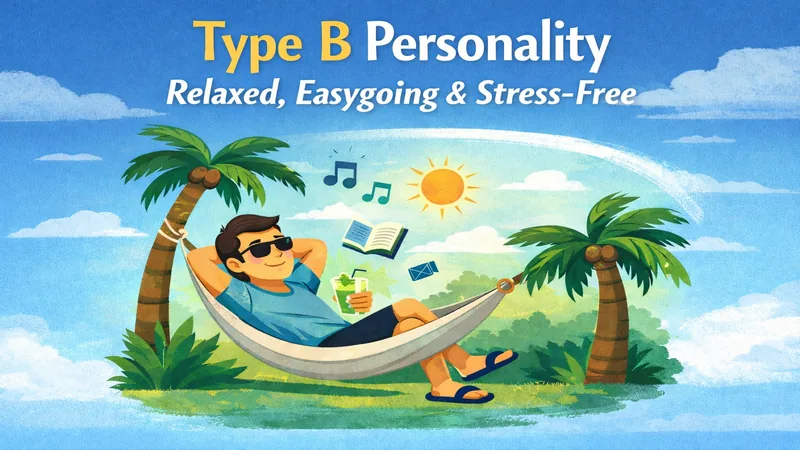
A Type B personality is one who is generally calm, patient, and easy going. Unlike highly competitive and time-urgent Type A people, Type B people prefer the idea of taking a relaxed approach to life. They enjoy the journey rather than being always in a searing manner that’s on their way to complete goals. They tend to deal with pressure more effectively, and also do not easily become stressed about small issues.
Understanding Type B personality traits can help you understand your strengths, have better relationships, and make the right career choice. In this article, we’ll discuss the meaning of Type B personality, comparing Type A vs Type B, we’ll check out some real-life examples of this personality type and finally explain the myths associated with this personality type.
Table of Contents
What Is a Type B Personality?
A Type B personality is a way of behaving and is described in personality psychology as someone who is calm, patient and less competitive than Type A people. If you are asking yourself what is Type B personality or what is Type B person, it means someone who comes to life in a relaxed and flexible manner. These people are not normally driven by a sense of urgency or constant pressure to do more in less duration of time.
In contrast to Type A individuals, those with a Type B personality tend to be calmer, more patient, and less driven by competition (Friedman & Rosenman, 1974; McCrae & Costa, 2008). The idea of Type A and Type B personality was attributed to two cardiologists Meyer Friedman and Ray Rosenman who were studying the subject of stress and heart disease. According to their theory, people having a Type B personality tend to have a low level of time urgency, low levels of hostility and a balanced stress response. This means that they are less likely to become frustrated when things do not go as planned. For the Type B person , personal satisfaction and well being is more important than strong competition. They can work hard but would rather work lots but not be rushed.
In psychology, Type B personality is related to better emotional control and the ability to cope. However, being relaxed does not mean lack of ambition — it is a different motivational style and a different temperament.
Difference between Type A and Type B
The concept behind Type A vs Type B personality is derived from behavioural psychology and focuses on the different patterns of personality, which affect stress levels, motivation and general lifestyle. While Type A personalities would be extremely competitive and aware of time, Type B tendencies are more inclined toward a balanced approach and steady progress which often leads to better physical and mental health(McCrae & Costa, 2008). Understanding the difference between Type A personality vs Type B can provide knowledge as to why some people succeeded when placed under pressure while others preferred to take a calm and unhurried approach to their work.
A Type A personality is competitive, ambitious, very organised and time conscious. Many of these persons are high in time urgency, impatient and high in achievement orientation. They have tight goals and work hard to achieve them. However, this constant-drive can sometimes lead to chronic levels of stress and becoming irritable and can even lead to health risks from having too much stress in the body.
In contrast, a Type B personality is more relaxed, patient and emotionally stable. When comparing the type A vs type B personality, the Type B people exhibit lower levels of hostility as well as a better emotional regulation. They are less likely to feel overwhelmed with deadlines and they are usually more flexible in the face of change. Their stress response system tends to be more balanced that can have a good impact on mental and physical well-being.
Another way that Type A vs Type B are different is the way they define success. Type A people tend to define success in terms of accomplishment and competition. Type B persons, on the other hand, find personal satisfaction, creativity and work life balance important.
It is important to bear in mind that these categories are not solid. Most people stand somewhere in between both types depending upon the situation. In personality theory the comparison is useful in helping us to understand behavioural tendencies, rather than label individuals permanently.
| Features | Type A Personality | Type B Personality |
| Stress Level | High Stress Response | Balance Stress Response |
| Temperament | Impatient, aggressive | Patient, emotionally stable |
| Work Style | Multi Tasking | Steady Pace |
| Reaction To Failure | Frustrated | Accepting and reflective |
| Time Urgency | Time Conscious | Relaxed about time |
Core Traits of a Type B Personality
Type B personality traits are generally seen as being associated with a calm temperament, emotional stability, and balance when it comes to approaching life. The idea of Type A and Type B personality was first proposed by cardiologists Meyer Friedman and Ray Rosenman during their research on stress and heart disease as such (Friedman & Rosenman, 1974). In personality psychology, these traits refer to consistent behavioural patterns that reflect the way that an individual thinks, feels, and responds to various situations.
One of the more obvious Type B personality traits is low time urgency. Another important characteristic is patience. A Type B person is usually tolerant and less prone to becoming frustrated over small problems. Their stress response is typically at an average level; it can be said they deal with pressure reasonable without being too anxious or aggressive. Lower levels of aggression, a crucial psychological factor in the study of type A and type B personality theory, are likewise related to this.
Type B individuals tend to have lower levels of hostility and greater emotional regulatory abilities that facilitate better coping with stress [Lazarus and Folkman, 1984; Matthews and Gump, 2002]. Adaptability is also common among Type B people. They have flexibility in their thinking and openness to change. Instead of being impulsive with their reactions, they bring reflective thinking to their decision-making. Many Type B people exhibit high levels of creativity as well, since they lack the boundless constraints of performance anxiety. Overall, type b personality traits are indicative of a balanced pattern of behaviour that has an easy-going and emotionally intelligent approach to things.
Real-Life Examples of Type B Personality
Understanding examples of Type B personality can help make the concept better understood and. In real life, the Type B is someone who is calm even in stressful situations and never panics easily.
Take for instance, when the student is in the middle of exams. A Type A student must feel a lot of pressure, may check the time and may worry about getting topmost marks. By contrast, a Type B personality student studies regularly but is easy-going. They are focused more on acquiring an understanding of the material, and are not competing with other people. Their stress response is maintained in a balance, which enables them to perform on a constant basis.
In a workplace environment, a Type B worker may work with tight deadlines and not be aggressive or frustrated about it. Instead of reacting off the top, they get things done in a calm manner and keep their relationships within the workplace positive. They can solve conflicts peacefully due to their emotions regulation expertise
Another example of Type B personality can be seen in the sports field. While a Type A athlete may be too competitive, a Type B athlete loves the game and is interested in personal improvement instead of only in winning. In daily life, it is the people like them who are often the ones who are patient in traffic, can hold to sudden changes, and have a healthy work-life balance.
Type B Personality and Stress — Why They Handle Pressure Differently
The relationship between Type B personality and stress is one of the most discussed topics in the personality psychology world. Research indicates that people who tend to have a Type B personality are likely to tend to have lower levels of chronic stress than those who are Type A. This difference is primarily attributed to their stress response mechanism and their behaviour pattern.
Type B people tend to express low time urgency and low hostility, and this tends to decrease the pressure on the person. When confronted by deadlines or unexpected obstacles, they are more likely to respond not with anxiety and aggression. Instead, they employ adaptive methods to cope with them such as Problem-solving, Emotional regulation, and Cognitive reframing. These strategies help them remain calm when they are under pressure.
Another reason why Type B personality and stress are connected differently is their perception regarding the competition. Unlike Type A personalities, who often find themselves constantly working toward achieving things and getting on top of others, Type B people tend to focus more on personal satisfaction and steady improvement. This helps in reducing performance anxiety and also in avoiding burnout.
Best Careers for Type B Personality Types
Type B personality Careers are in creative leisure work such as writing, graphic design, music or content creation fit their reflective thinking and intrinsic motivation. Many Type B individuals also excel in a psychology, counselling, teaching or social work occupation due to their good emotional regulation and ability to remain calm under pressure.
They may do well also in research-based positions, human resources or healthcare professions where empathy and steady decision-making are important. To a great extent, in contrast to highly competitive situations, these careers offer support to balanced levels of stress and a work-life balance.
Are You a Type B Person? (Personality Quiz)
Most individuals possess characteristics of both Type A personalities and Type B personalities depending on the circumstances; personality occurs along a continuum and not in discrete categories (McCrae & Costa, 2008). A type B personality quiz can help you to understand your patterns of behaviour, the way you react to stress and your style of motivation. While this isn’t classed as a clinical psychological assessment in some sense, it should give you a basic idea with regards to if you’re prone to common type B personality traits or not.
Answers to the following questions should be provided honestly:
- Are you generally relaxed when confronted with deadlines?
- Do you favour steady advance rather than standing head to headstress in competition?
- Do you rarely feel any time urgency or pressure to hurry?
- Are you able to deal in a calm and balanced manner with conflicts?
Scoring:
In case you answered the majority of the questions with a Yes, there are high possibilities that you are a Type B personality.
If a variety of answers lies in between this, then you may also have a combination of Type A and Type B traits.For most in personality psychology, most people fall along a continuum and do not fit either/or. This questionnaire of simple type b personality is for self-reflection, rather than diagnosis.
Is Type B Personality a Disorder? (Big Myth Section)
Many people discover the incorrect usage of, for example, “type B personality disorder” because it is important to clarify that Type B personality is not a psychological disorder. In the field of personality psychology, Type A, and Type B are actually behavioral patterns, not even diagnoses in specific. They summarise how people tend to react to stress, competition and situations in everyday life.
The source of the confusion is often that the term “Type B” tends to sound similar to personality disorders as they appear in abnormal psychology categories. However, these are totally different concepts. A personality disorder is a clinically recognised mental health disorder that has a significant impact on thoughts and emotions and also behaviour. In contrast, Type B personality is simply manifested as a relaxed temperament and harmonious response to stress.
There is not any medical diagnosis for type B personality disorder in Diagnostic and Statistical Manual of Mental Disorders (DSM). Being calm and patient and being less competitive is a personality style — not a mental health problem.
Understanding this difference helps in removing stigma and helping to eliminate some common myths about Type B personality.
Common Misconceptions About Type B Personality
There are several common misconceptions of Type B personality that tend to cause confusion. One big myth that is there is that Type B individuals are lazy or unmotivated. In reality, they tend to be simply less competitive and time urgent. Their motivation is usually intrinsic rather than being based on external pressure.
Another misconception is that Type B people do lack ambition. This is not true. They can be goal oriented and successful, but not constantly hustle, rather they would like steady progress. Their easy-going attitude does not mean they do not accept responsibility, it means they deal with stress in a different way.
Contrary to popular belief, Type B personalities are not lazy and unmotivated but are intrinsically motivated and deal with stress differently compared to Type A personalities” (American Psychological Association [APA], 2023). Some people also think that Type B personalities are also careless or disorganised. While they won’t display extreme levels of urgency like people who are Type A, they are able to plan and get work done. They just approach work with a balanced stress response.
Finally, many believe that Type B is the counterpart of success. However, personality psychology suggests that it is possible that different types of behavioural patterns lead to success in different types of ways. Type B people tend to have better control over their emotions and enjoy a better work life, leading to long-term well-being.
FAQs
What Is The Type B Psychologist Personality
In psychology a Type B personality means a behavioural pattern with the traits of calmness, patience, and low time urgency. According to personality theory, Type B people exhibit even emotional control and a moderate stress reaction. They tend to be less competitive than Type A personalities and favor steady progress as opposed to constant pressure.
Is Type B personality bad or good?
Type B personality is neither good nor bad. It is actually just a different temperament style. While Type B people may be less driven, they tend to be more relaxed in the way they deal with stress and maintain a healthy work-life balance. Every personality type has positive and negative aspects.
Is a person Type A as well as Type B?
Yes. Most of the people fall on a continuum instead of fitting in. A person can exhibit Type A personality in a competitive situation and Type B personality in personal life.
Are Type B People Lazily or They are Relaxed?
Type Bs are typically not lazy but rather relaxed. Their motivation is often intrinsic and they want to work in a calm rather than hurried way.
Who deals better with stress and what personality is it?
Generally, Type B people cope with the stress much better because of their balanced stress response and the lower level of hostility.

Abhishek Gaur is a psychology focused content creator with practical experience in human behavior and personality analysis at KnowThePersonality
